How to Run a Pull Planning Workshop: A Step-by-Step Guide for Construction Teams

A pull planning workshop is a facilitated session where trades plan their work backward from a milestone and agree the handoffs between them. The people who do the work build the plan, so it is realistic and owned by the crew. This guide gives you eight steps, a sample three-hour agenda and a free template to run your first session.

What Is a Pull Planning Workshop?

Pull planning means planning backward from a finish line. The team starts at a milestone and asks what must be done just before it, then what must happen before that. In Last Planner System terms, it sits between the milestone plan and the lookahead plan. The LCI Standard Work guide describes four levels: milestone planning, phase pull planning, lookahead planning and weekly work planning.

A pull planning workshop is the session where the phase pull plan gets built. It is short, focused and collaborative.

Pull Planning vs a Traditional Schedule

A traditional schedule is pushed down from the office. Durations and sequence are set by a planner, then handed to the trades.

In a pull plan, the trades set the sequence and the handoffs themselves. They know their crews, their lead times and what they need from the trade before them. That is why the plan holds up better on site.

Who Should Be in the Workshop?

The key people are the last planners: those who can commit their company’s labour and materials to the plan, as Construction Dive explains. Their promises are what make a pull plan real.

  • Last planners from every trade working in the phase
  • The project manager or site manager, who owns the milestone
  • Designers or engineers, when information needs to flow to the trades
  • The safety lead, so access, sequencing and hazards are planned in
  • A facilitator to run the session and a scribe to capture the plan

Leave out anyone who cannot commit resources or make decisions. A smaller room usually plans better.

What to Prepare Before the Workshop

Good sessions are won before the day. The LCI standard work guide recommends sending invitations at least a week ahead. For materials, the LCI hand-off work planning chapter lists large sticky notes, usually one colour per company, plus marker pens, fine-tip pens and project drawings.

  • Confirm the milestone and its target date from the master programme
  • Book a room with a long, clear wall and plenty of space to move
  • Set up the wall: milestone on the right, start point on the left
  • Bring drawings, a site plan, a logistics plan and the master programme
  • Agree what “done” means for the milestone, in writing
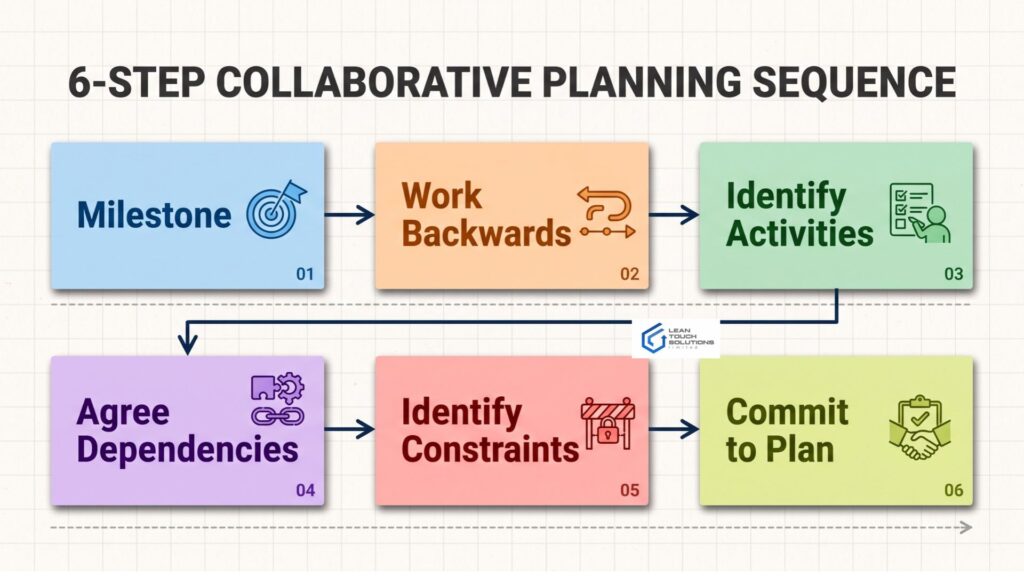
pull planning workshop eight step process diagram

How to Run a Pull Planning Workshop: 8 Steps

Step 1: Open with the Goal and Ground Rules

State the purpose in one sentence. Explain that the plan belongs to the trades, not the office. Agree a few simple rules: one conversation at a time, challenge ideas not people, and say when something is not realistic.

Step 2: Define the Milestone and What “Done” Looks Like

Write the milestone on the right of the wall, with its target date. Then agree the definition of done. For example: slab poured, cured, signed off and ready for the next trade. A fuzzy finish line creates a fuzzy plan.

Step 3: Work Backward, Trade by Trade

Start from the milestone. Ask the last trade what they need to finish. Each trade writes their tasks on sticky notes, with durations, and places them on the wall in reverse order.

Keep to one colour per company. Keep each note short: task and duration.

Step 4: Hold the Handoff Conversations

Where one trade finishes and another starts, get both to talk. What exactly is being handed over? In what condition? By when? These conversations are the heart of the workshop.

Write the agreed conditions down. A handoff with no conditions is just a hope.

Step 5: Squeeze the Plan

Now step back and look at the whole wall. Challenge durations. Look for waiting, rework and work that could overlap. Ask what could safely happen in parallel.

If the same problems keep appearing, a short Kaizen Event afterward can fix them for good.

Step 6: Log Constraints and Assign Owners

Anything that could stop a task from starting is a constraint. Examples are missing drawings, late materials, permits or access. Write each one down, give it an owner and a needed-by date.

Step 7: Get Firm Commitments

Ask each trade a direct question: can you commit to this? Only real yes answers count. If someone hesitates, find out why and fix it now, not on site.

Step 8: Capture the Plan and Set the Follow-Up

Photograph the wall before anyone leaves. Type the plan into a shared record, then book the first weekly work planning huddle. The Last Planner® System uses that huddle to turn the pull plan into weekly commitments.

A Sample 3-Hour Pull Planning Agenda

Adjust the timings to suit the size of your milestone.

  • 10 min — Welcome, purpose and ground rules
  • 15 min — Confirm the milestone, definition of done and known constraints
  • 45 min — Post tasks backward from the milestone, trade by trade
  • 10 min — Break
  • 40 min — Handoff conversations between neighbouring trades
  • 20 min — Squeeze the plan: durations, waste and overlap
  • 20 min — Log constraints and assign owners
  • 20 min — Commitments and next steps
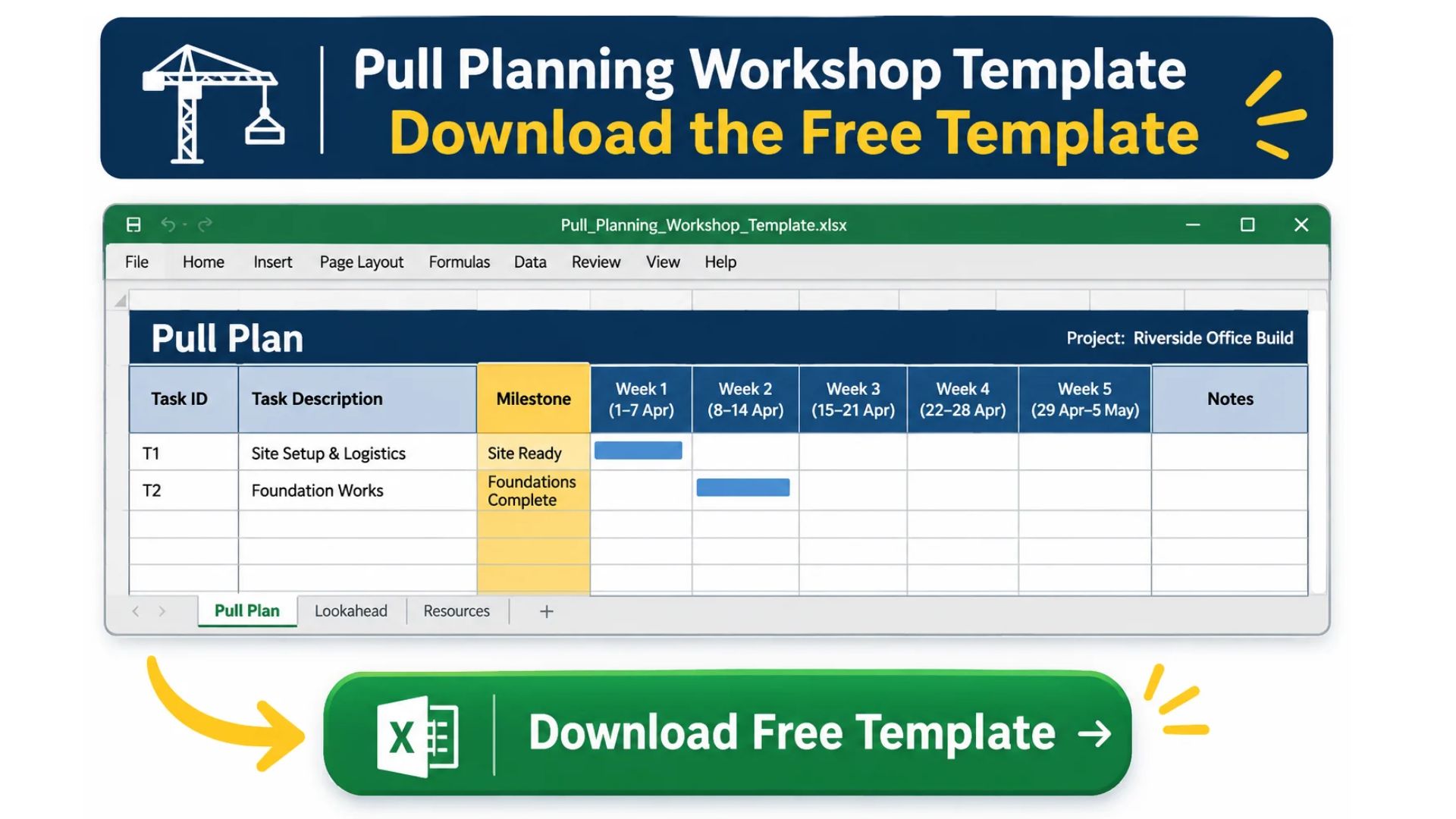
pull planning workshop template Excel pull plan tab

Click here to Download the Template

Download the Free Pull Planning Workshop Template

We built an Excel template to run the session end to end. Download the free Pull Planning Workshop Template. It has seven tabs:

  • Setup — workshop details, milestone, definition of done and a prep checklist
  • Participants — who is invited, who can commit and who attended
  • Pull Plan — a week-by-week board that counts back from your milestone date
  • Handoffs — conditions of satisfaction for every trade-to-trade handoff
  • Constraints — an owner, a needed-by date and an overdue flag for every blocker
  • Commitments and PPC — weekly commitments and Percent Plan Complete
  • Agenda — the three-hour running order, with clock times that update

Print the Pull Plan tab for the wall, or project it. Fill the yellow cells and the grey cells calculate for you.

Common Mistakes to Avoid

  • Inviting people who cannot commit crews or materials
  • Letting the office build the plan and the trades just nod along
  • Skipping the handoff conversations and writing vague conditions
  • Treating the pull plan as finished on the day, with no weekly follow-up
  • Never logging constraints, so problems surface on site instead

Behaviour matters too. People only speak up in the room if it feels safe to say “that is not realistic”. Our guide to lean behaviours in construction covers how leaders build that habit.

Where Pull Planning Fits with Takt Planning

Pull planning suits phases where trades need to agree a sequence and handoffs. If a phase repeats across zones or floors, Takt Planning can set the steady rhythm that the pull plan then fine-tunes. Many teams use both.

Getting Started with Pull Planning in Ireland

Lean Touch Solutions has supported contractors across Ireland, the UK and Europe with pull planning and the Last Planner System since 2012. Our LCI-registered trainers can facilitate your first workshop on your own live milestone, so your team learns by doing. Book a free 30-minute consultation to talk through your first session.

Frequently Asked Questions

A pull planning workshop is a facilitated session where trade partners plan their work backward from a milestone, agree handoffs between trades and identify constraints, so the plan is realistic and owned by the people doing the work.

Most sessions run two to four hours, depending on the size of the milestone and how many trades are involved. A three-hour agenda works well for a typical phase.

The last planners from every trade in the phase, meaning people who can commit crews and materials, plus the project manager, a facilitator and a scribe. Add designers and the safety lead where relevant.

A long clear wall, large sticky notes in one colour per company, marker and fine-tip pens, project drawings, the master programme and a clear milestone with a definition of done.

Lean Touch Solutions provides LCI-registered Last Planner System and pull planning training for contractors across Ireland, the UK and Europe.

In short:

A pull planning workshop works because the people who do the work build the plan. Prepare well, define done, plan backward, agree the handoffs, log constraints and get real commitments. Then follow up every week. Download the template and run your first session.

Picture of Lean Touch Editorial Team

Lean Touch Editorial Team

Founded in 2012, our Team has partnered with clients across Europe to improve productivity through Lean Transformation, Behavioural Change, and Practical Tools.

Talk to Lean Expert

Free 30-minute consultation. No commitment required.

Looking for implementation and support for your project?

Get In Touch

Contact For 2 or 3 Day Training

Contact us below for more information on this course