

Takt Planning in Construction: The Complete Guide for Irish & European Contractors (2026)

Construction schedules built on Critical Path Method logic look precise on paper and fall apart on site — one delayed trade cascades into every zone behind it. Takt planning, a rhythm-based scheduling method borrowed from lean manufacturing, is why a growing number of Irish and European contractors are hitting handover dates without the usual firefighting. This guide breaks down what takt planning is, how to build a takt plan step by step, and how it fits alongside the Last Planner System on a live programme.

What Is Takt Planning in Construction?

Takt is the German word for a musical beat or pulse. In construction, takt planning means dividing a building into zones and moving each trade through those zones at a fixed, shared rhythm — the “takt time” — instead of letting every trade run its own schedule at its own pace.

Rather than a bar chart showing when a task starts and ends, a takt plan is read as a diagram: zones down one axis, time across the other, with each trade’s colour-coded band moving steadily from zone to zone. That visual format is what makes flow — and the moment flow breaks — obvious to everyone on site, not just the scheduler.

Takt Time vs Takt Planning: What's the Difference?

The two terms get used interchangeably, but they describe different things:

  • Takt time is the number — the pace at which work must move through each zone to hit the project deadline. The base formula is Net Available Production Time ÷ Demand, adapted in construction to account for zone count and crew capacity.
  • Takt planning is the process — zoning the building, sequencing trades, setting the takt time, and building the full “takt train” that every trade partner works to.

Understanding the calculation is step one. The real value comes from the planning framework built around it — which is what the rest of this guide covers.

Material reuse and carbon cuts now sit in the same conversation. That is where the biggest gains are.

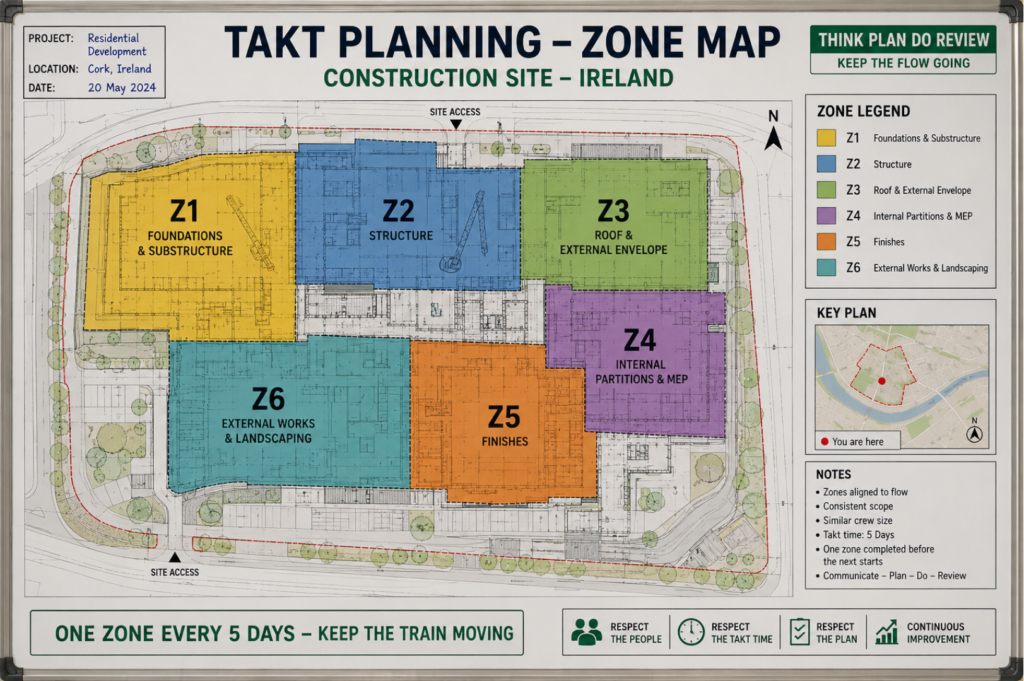
takt planning zone map construction site Ireland

Why Takt Planning Is Trending on Irish and European Sites in 2026

Labour shortages, tighter margins and client pressure for reliable handover dates have pushed contractors to look for scheduling methods that expose problems early rather than at snagging stage. Three factors are driving adoption across Ireland and Europe this year:

  • Predictability over optimism — CPM schedules tend to hide float and slippage until it’s too late to recover; a takt plan makes a broken rhythm visible within days, not weeks.
  • MMC and modular delivery — modern methods of construction depend on synchronised trade handoffs between factory and site, and takt planning is the scheduling layer that keeps that synchronisation intact.
  • Client and funder scrutiny — public and private clients increasingly ask for evidence of lean scheduling methodology at tender stage, not just a Gantt chart.

How Takt Planning Works: Zones, Trains and Trades

Building a workable takt plan follows four stages. Skipping any one of them is the most common reason takt plans fail on real sites.

Step 1: Divide the Project into Zones

Break the building into zones of roughly equal work content — not equal floor area. A large open-plan floor might be one zone; a floor with complex M&E risers might need splitting into two or three. Zone boundaries should follow natural work breaks (a corridor, a stair core) so trades can move cleanly without doubling back.

Step 2: Calculate Takt Time

Set the pace every trade will work to — commonly one, two or five working days per zone, chosen so the total programme duration matches the contract completion date. A takt time that’s too aggressive for the slowest trade will break the rhythm in week one; one that’s too slow wastes the schedule advantage takt planning is meant to deliver.

takt_time_formula

Step 3: Build the Takt Train

Sequence every trade into a “train” moving through the zones in order, each trade one takt period behind the one in front. This is the artefact that goes up in the site office and gets walked through in the weekly Last Planner huddle — every trade partner should be able to find their colour on the train and see exactly which zone they’ll be in each week.

Step 4: Steer and Control the Plan

A takt train is not “set and forget.” Takt steering means the project team actively manages constraints — materials, permits, design information — ahead of the train, while takt control means removing blockers on site in real time so no trade stalls mid-zone. Together, planning, steering and control form what the Lean Construction Institute calls the Takt Production System.

Takt Planning vs the Last Planner System — Do You Need Both?

Takt planning and the Last Planner System solve different problems and work best combined, not chosen between:

  • Last Planner System builds reliable short-interval commitments through pull planning and weekly work planning — it answers “what should happen next and who is committing to it.”
  • Takt planning builds the underlying rhythm and flow of the whole programme — it answers “at what pace does every trade need to move to hit the date.”

In practice, the takt train sets the macro rhythm and the Last Planner huddles steer week-to-week execution against it. Contractors running both report far fewer of the schedule surprises that a CPM-only or Last-Planner-only approach tends to miss.

Benefits of Takt Planning for Contractors

  • Predictable, evidence-based completion dates instead of optimistic CPM float
  • Faster identification of trade delays — a broken rhythm is visible within a day or two, not discovered at month-end
  • Lower waste from overproduction, waiting and rework as trades move at a shared, sustainable pace
  • Clearer accountability — every trade partner can see their zone, their date and their neighbours on the train
  • Stronger tender and client reporting, with a visual schedule that’s easier to explain than a 4,000-line CPM programme

Common Mistakes When Implementing Takt Planning

  • Zoning by floor area instead of work content, which creates uneven takt periods from the start
  • Setting takt time around the fastest trade rather than the slowest, guaranteeing an early break in the rhythm
  • Treating the takt train as a one-off deliverable instead of steering and controlling it weekly
  • Running takt planning in isolation from the Last Planner System, losing the short-interval commitment layer that keeps the train on pace
  • Introducing takt planning mid-project without training the site team on how to read and work to the train

Getting Started: Takt Planning Training in Ireland

Lean Touch Solutions has delivered Takt Planning training and on-site implementation for contractors across Ireland, the UK and Europe since 2012, alongside The Last Planner® System and wider lean construction programmes. Our LCI-registered trainers build your first takt plan with your own project data, not a generic case study, so your site team leaves able to run it themselves. Book a free 30-minute consultation to talk through takt planning for your next project.

Book your Tank Planning course here.

Frequently Asked Questions: Pull Planning Workshops in Ireland

Takt planning is a lean scheduling method that divides a construction project into zones and moves each trade through those zones at a shared, fixed pace called takt time, creating a predictable rhythm across the whole programme.

The base formula is Net Available Production Time ÷ Demand. In construction this is adapted to the number of zones and the capacity of the slowest trade, so every trade can realistically hold the same pace.

No. Takt planning sets the overall rhythm and sequence of the programme; the Last Planner System manages short-interval, weekly commitments. Most contractors run both together, with takt setting the macro pace and Last Planner steering execution.

Any project with repeatable zones and multiple trades — residential, commercial fit-out, and modular or MMC builds in particular — sees the biggest gains, since the method depends on dividing work into comparable, repeatable units.

Lean Touch Solutions provides LCI-registered Takt Planning training and implementation support for contractors in Ireland, the UK and Europe.

Picture of Lean Touch Editorial Team

Lean Touch Editorial Team

Founded in 2012, our Team has partnered with clients across Europe to improve productivity through Lean Transformation, Behavioural Change, and Practical Tools.

Talk to Lean Expert

Free 30-minute consultation. No commitment required.

Looking for implementation and support for your project?

Get In Touch

Contact For 2 or 3 Day Training

Contact us below for more information on this course